Inspiring Academic Communities to Embrace International Cooperation and European Project Opportunities
16 February 2026 | AGH University of Krakow, Poland
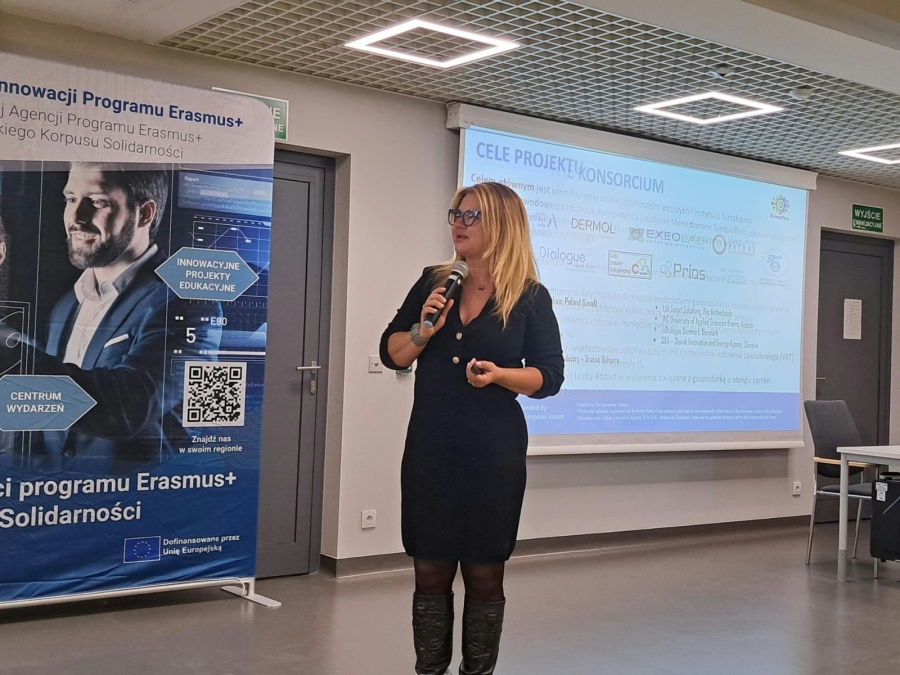
The SymbioTech project was presented during the inaugural conference of the new Erasmus+ InnHUB Kraków, held on 16 February 2026 at the AGH University of Krakow. The event marked the official opening of the new regional Erasmus+ InnHUB headquarters at the AGH Centre of Energy and provided an important platform for promoting international cooperation, educational innovation and the development of future-oriented competencies.
The conference brought together university authorities, academic staff, Erasmus+ project coordinators and beneficiaries, representatives of educational institutions, public administration, non-governmental organisations and other stakeholders engaged in European cooperation. A significant moment of the event was the signing of a cooperation agreement between AGH University of Krakow and the Foundation for the Development of the Education System (FRSE), Poland's National Agency for the Erasmus+ Programme and the European Solidarity Corps.
SymbioTech as an Example of Successful International Collaboration
During the conference, Dr Eng. Monika Pec from the Faculty of Management at AGH University of Krakow delivered a presentation entitled “SymbioTech Project – A European Alliance for Development”, introducing the project's objectives, international partnership and innovative approach to industrial symbiosis and circular economy education.
The presentation demonstrated how international Erasmus+ projects can connect universities, businesses, vocational education institutions and other organisations around common challenges. Particular attention was given to the importance of developing new competencies, exchanging knowledge and creating educational solutions that respond to the evolving needs of European economies.
Dr Pec presented SymbioTech as a practical example of how cooperation between partners from different countries can contribute to the development of innovative learning pathways, specialist training materials and digital solutions supporting industrial symbiosis.
The project illustrates how European partnerships can help bridge the gap between academic knowledge and business practice while supporting the transition towards more sustainable and resource-efficient economic models.
Encouraging AGH Staff to Take the First Step Towards European Projects
One of the central objectives of the presentation was to encourage AGH academic staff and researchers to become more actively involved in preparing and implementing international project proposals.
Dr Pec emphasised that participation in international projects should not be perceived as an opportunity reserved exclusively for highly experienced research teams or large institutions. Instead, it represents an accessible pathway for academic staff interested in developing new ideas, expanding professional networks and establishing cooperation with partners across Europe.
The presentation aimed to reduce the uncertainty and hesitation that may discourage researchers and lecturers from applying for European funding or joining international consortia.
Drawing on the experience of SymbioTech, Dr Pec highlighted the importance of openness, initiative, mutual trust and a willingness to cooperate with organisations representing different countries, sectors and professional backgrounds.
The key message was that international cooperation begins with the courage to take the first step: sharing an idea, approaching potential partners and exploring opportunities for joint project development.
Beyond Funding: The Added Value of European Partnerships
An important part of the presentation concerned the broader benefits of international cooperation, extending well beyond the financial support available through European programmes.
Participation in international projects offers universities and their staff opportunities to develop new teaching methods, strengthen research and management competencies, exchange good practices and establish long-term professional relationships.
For academic institutions, such partnerships can also contribute to internationalisation, the development of innovative curricula, stronger links with industry and greater visibility within European education and research networks.
The SymbioTech project was presented as an example of how complementary expertise and experience can be combined to address complex challenges that individual institutions would find difficult to tackle independently.
Building a Culture of International Engagement
The Erasmus+ InnHUB Kraków inaugural conference provided an excellent opportunity to promote SymbioTech among representatives of the academic and educational communities while encouraging wider participation in European cooperation initiatives.
By sharing the experience of developing and implementing an international project, Dr Pec sought to inspire other AGH employees to explore Erasmus+ opportunities, establish new partnerships and transform their professional ideas into collaborative European initiatives.
The presentation reinforced the message that successful international projects depend not only on funding and formal procedures, but also on people, trust, shared ambitions and the willingness to learn from one another.
SymbioTech demonstrates that international cooperation is more than a project management activity. It is a powerful mechanism for developing competencies, connecting organisations, exchanging knowledge and creating lasting value for universities, businesses and society.
Dissemination activity: Erasmus+ InnHUB Kraków Inaugural Conference, 16 February 2026, AGH University of Krakow. Presentation delivered by Dr Eng. Monika Pec, Faculty of Management, AGH University of Krakow.
 Funded by the European Union. Views and opinions expressed are however those of the author(s) only and do not necessarily reflect those of the European Union or the European Education and Culture Executive Agency (EACEA). Neither the European Union nor the granting authority can be held responsible for them.